Translate

Showing posts with label Oscars. Show all posts

Saturday

Benh Zeitlin on Wendy, his wild re-imagining of Peter Pan

Re-Imagining Peter Pan

Film-maker Ben Zeitlin's debut was an Oscar-nominated success. But there was a long wait for a follow-up.

Benh Zeitlin is one of the most unconventional filmmakers I have ever met. Born in New York to a Jewish father and Protestant-raised mother, both of whom are urban folklorists, the 38-year-old was thrust into the spotlight in 2012 when his ambitious debut feature, Beasts of the Southern Wild, became the talk of the Cannes Film Festival, before garnering four Oscar nominations.

Until then, he had operated in his own bubble, crafting artisanal shorts as part of a collective of like-minded creatives called Court 13. Beasts, a dynamic bayou fable told through the eyes of a spirited six-year-old girl, put them on the map, and left many excitedly wondering what they would do next. Incredibly, it has taken until now, and the release of Wendy, a loose and passionately-realised adaptation of Peter Pan, written by Zeitlin and his sister Eliza, to find out.

“The Oscars were like visiting another planet,” recalls Zeitlin from his home in New Orleans. He fell in love with the city while filming Glory at Sea, the poetic short that opened the door for Beasts, in Louisiana, less than a year after Hurricane Katrina. Then, “it was like a ghost town, and really dangerous,” he told me in Cannes. He’d been planning to return to New York. “But, right near the end, I started to realise I was not going to go back. That I somehow had my feet stuck, essentially.”

No wonder the Oscars, with their glitz and feverish media buzz, made him feel discombobulated. “It was a world that I had only seen on television,” he says today, “and it felt like being propelled into a TV show. It was mind-blowing and incredibly surreal. And, you know, amazing.”

If there was external pressure and expectation, it wasn’t this that concerned Zeitlin and his collaborators, so much as that the rights to their next film were owned by Fox Searchlight (now Searchlight). Beasts had been backed by Cinereach, a non-profit that allowed the filmmaker to work in the same organic, intuitive, time-consuming way he’d always done. This was unusual in an industry where “efficiency becomes kind of the number one principle,” says Zeitlin, explaining that when they cast a film, “we’re going to search until we find the one person who can play this role, no matter how long that takes, and wait to shoot the film until they’re exactly the right age. . .  Obviously, this film took took a very long time.”

Friday

Guillermo del Toro on the deeper meaning in ‘The Shape of Water’


 Stephen Applebaum


The film tells of a unique love story between a mute cleaning lady played by Sally Hawkins and an Amazonian-fish man played by Doug Jones 
 
Guillermo del Toro is making the biggest splash of his life with The Shape of Water. A spin on Beauty and the Beast that could only have sprung from the imagination of the man who made Spanish Civil War fantasy Pan’s Labyrinth, the film has been winning awards since taking the top prize at the Venice Film Festival last year.

Now it is the movie to beat at the Oscars in March, with 13 nominations. The bizarre love story between a mute cleaning lady (Sally Hawkins) and an Amazonian fish-man (Doug Jones) is one of Del Toro’s proudest achievements to date. He has put his next project on hold, to bang the drum for the film around the world.

“I made the big mistake of finishing Devil’s Backbone [a moving ghost story set in a Spanish orphanage] and going immediately into [vampire action-horror movie] Blade II,” he explains.

“I have the nagging notion that I should have promoted The Devil’s Backbone more, because it’s still one of my favourite movies and it’s still a movie that not many people know. And I don’t want it to happen again.”

Read the full feature here: https://www.thenational.ae/arts-culture/film/guillermo-del-toro-on-the-deeper-meaning-in-the-shape-of-water-1.699621

Cate Shortland: Lore


Wednesday

Say Yes To No

Chile's Pablo Larrain takes down Pinochet in the Oscar-nominated drama, No 

"WITHOUT memory you are dead. You are plastic,” says the Chilean filmmaker Pablo Larrain. “If you don’t have memory on your side, you tend to make the same mistakes again and again. So it’s good to rethink a few things.”
Larrain has been doing this ever since his dark and troubling debut feature, Tony Manero, used a psychopathic John Travolta obsessive as a metaphor for the violence perpetrated by General Augusto Pinochet’s brutal military junta. He returned to the subject in his second film, Post-Mortem, set during the bloody coup that brought Pinochet to power in 1973. Some in Chile wondered why Larrain couldn’t let the past lie. “They said, ‘Why don’t you make a surfing film or whatever?’ But I wanted to do it because I still didn’t get it yet. I didn’t understand it.”
Born in 1976, Larrain was too young to experience the full horror first hand; however, it haunts his generation “like a big ghost”, he told me after the world premiere of Post-Mortem in 2010. “Pinochet died [in 2006] with $30 million and free. We still have 3000 people disappeared. We have nobody in jail. If somebody thinks it’s enough, I would say, ‘I don’t agree.’”
A third film, No, based on a play by Antonio Skarmeta, was already at the writing stage. “It’s going to be a trilogy and that’s it,” he laughed. “I swear I will go and do something else.”
No now arrives in the UK already having made history by becoming the first production from Chile to be nominated for a best foreign language film Oscar. Part of the reason, possibly, is that in dramatising the story of how a group of television advertising men helped to oust Pinochet in a 1988 plebiscite that was supposed to extend the dictator’s rule, Larrain has fashioned his most mainstream movie to date. Where Tony Manero and Post-Mortem were dark, twisted and oblique, with deranged, opaque protagonists, No is instantly accessible and relatively light in tone. The difference was intentional, he says.
“My previous films were made under my imagination; I created those situations in the real context of what happened in my country. This tells a real story about a real campaign with real people that did something that changed the history of my country. So we had to tell it in a proper way in order to deliver it to a wide audience. Not because we wanted to make it wider. We had to.”
The central irony of No is that Pinochet was defeated by Mad Men using advertising to sell the idea of l’alegria, or happiness, to the masses as an alternative to the dictator’s repressive rule, in the same way that they would sell fizzy pop, using humour, music, and joy.
“The advertising logic comes from capitalism,” says Larrain. “And that capitalism is a model that Pinochet imposed. So he created the tools that pulled him out. It’s like we say in Spanish: you create your own enemy.”
Not everyone believed that the “No” campaign would be successful. Pinochet controlled everything, including the media. The opposition’s TV broadcasts (the “Yes” and “No” campaigns were given 15 minutes airtime a day each for a month) would be censored, they thought; the vote would be rigged, the election a sham. After all, who’d ever heard of a dictator being voted off the stage democratically? They “usually die in power, fat, rich and shooting people”, says Larrain.
Chile hadn’t gone to the polls since the Socialist Salvador Allende was elected president in 1970, and people feared reprisals. To overcome this, the architects of the “No” campaign “created an environment where you could express yourself”, says Larrain.
“They let the people know that they can still think freely. They said, ‘Don’t be afraid. When you vote, vote for what you think is really better. Don’t let anybody tell you what to do.’ We’d had 15 years where freedom was a metaphor. That is why we show the vote in the film.”
The margin of victory was slim, but it was enough to rid Chile of Pinochet. The “No” campaign had done its work simply by promoting an abstract idea: happiness.
In the film, Mexican star Gael García Bernal plays Rene Saavedra, an amalgam of several real people involved with the operation. Some people found the campaign trivial, Bernal says, while others thought it was “disrespectful to the pain that many people carried”. Moreover, in an echo of the Arab Spring, it never considered what would come next.
“Ultimately it was a partial win because the economic system, the privileges, stayed kind of the same,” claims Bernal. “Chile is a country that is doing well economically and yet all of Latin America has free education, except Chile. So there are contradictions that are still there and still hurtful.”
The film is rife with ambiguity and ambivalence, ending on a sobering note of reality rather than unalloyed optimism. Its very make up, too, is ambiguous, comprising new and old footage blended to perfection by shooting with actual U-matic cameras from the period.
Not many survive other than as museum or art pieces, but a global hunt turned up 20 which a company in Hollywood was able to cannibalise into four working units. “They were like people,” says Larrain. “They were all different and they would get tired. So we had to use one and then another day another one, because they wouldn’t be in good shape.” The results were so authentic, Larrain claims, that he couldn’t always distinguish between the archive footage and new material when they were assembling the edit. “When we had that confusion, I said, ‘We got it!’”
Whether he also gets the Oscar will be revealed on 24 February.
First published in The Scotsman, 4/2/13
© Stephen Applebaum, 2013

Saturday

On The Town With Ben Affleck

Ben Affleck looked like a spent force creatively in the first half of the noughties. His screenwriting Oscar for Good Will Hunting, shared with Matt Damon, seemed a distant memory lost in the fog of bad movie choices – Gigli, Jersey Girl, Surviving Christmas, Paycheck – and lurid tabloid stories about his relationship with Jennifer Lopez.
Trapped in the glare of a media spotlight that he believed was damaging him personally and professionally, Affleck tried to disappear.
"I didn't like what happened to me and what happened to my life. The way it felt," he says. "I also felt that if I don't do anything, almost like don't show up, don't do an interview, talk to anybody, almost didn't leave my house except to go to Starbucks, that some of that would abate. It was very destructive and I hated it."
When he resurfaced at the Venice Film Festival two years later, in 2006, as the star of Hollywoodland, Affleck was a different man. He was married to actress Jennifer Garner and had recently become a father for the first time, giving him a stability he had hitherto lacked. When the festival closed, he walked away with the Volpi Cup for best actor, for his performance as tragic Superman actor George Reeves.
Last September he returned to Venice as the director and star of The Town, his first time behind the camera since his 2007 directorial debut, Gone Baby Gone. Based on Chuck Hogan's novel Prince Of Thieves, the film takes place in the Charlestown district of Boston where bank robbery is practically a family business, passed from generation to generation.
Affleck plays the leader of a gang who starts to rethink the life handed down to him by his jailed father (Chris Cooper) when he becomes involved in a relationship with a woman (Rebecca Hall) taken hostage during a heist.
The Town shares certain thematic similarities with Good Will Hunting and Gone Baby Gone. "Chief among them is the idea that where we grow up really has a lot to do with shaping what we become," he says, "and the difficulty in escaping that, and the tension between those things. It's not easy to change oneself, even if we know we're doing the wrong things."
Affleck appears to have spent a lot of time trying to break away from inherited attitudes to life and work. As a struggling actor, he took any work that came his way.

His "Communist old man", a janitor with a "working-class ethic", had "always kind of beat into my head, maybe more than I needed," Affleck says. "This thing like, 'Do what you got to do. Take a job. Make money.'"

Consequently, the Bostonian actor wasn't snobbish about his choices; he just took "whatever came down the pike and was going to put food on the table". His father was no help financially, although he does seem to have provided his son with a vivid life lesson.

"He was in the tank," Affleck says. "He'd been living on the streets for two years and ended up going and getting cleaned up, getting off drugs and alcohol, and got a house. So I had a sense from that that living life requires sacrifice, and you got to do what you got to do. So I did that."

Over the years, his feelings towards acting went from love to dislike. He says at first he felt he was doing something interesting, and then it became about "money and perception, and the idea that you had to do a certain kind of movie that just never ended up being all that good".

He told himself that acting didn't matter after all, that "it's just all bullshit. It's all just a bunch of actors running around in tights.

I felt ashamed that that's what I did, because I didn't think it was real or socially relevant. I feel differently now. I'm not ashamed of it. For better or worse it's become extremely culturally relevant." (A fact his younger brother, Casey, pounced on with his hoax Joaquin Phoenix documentary, I'm Still Here.)

Eventually Affleck reached a point where he felt he should just "sock away some money, make hay while the sun shines". He was his father's son alright, although looking back he says, "I don't think the Socialist janitor work ethic applies to being in Pearl Harbor. I don't know how to reconcile the two of those things."

By the time he decided to withdraw, his bank account was in good shape; he was miserable and unfulfilled, however. Reflecting the theme of his films, he says that he started to reassess his life and to consider "not what my father thinks I should do or what other people think I should do, or agents or any of this other stuff, but really trying to go, 'What do I really want to do? What kind of life do I want to have? What kind of person am I really? What do I care about?'" The process led him to Hollywoodland and, presumably, Gone Baby Gone.

It was clear from his first stint in the director's chair that Affleck was an actor's director, an impression reinforced by the strong performances from the likes of The Hurt Locker's Jeremy Renner, Mad Men's Jon Hamm, Gossip Girl's Blake Lively and Rebecca Hall in The Town. Affleck, who replaced Christian Bale in The Burial, Terrence Malick's follow up to The Tree of Life, praised his cast in Venice, saying that when you have actors of their calibre, you don't really need to direct.

Inevitably, he has grown in confidence as a director. The first time out, on Gone Baby Gone, Affleck didn't even know if he would cross the finishing line or not. He discovered that directing is "a truly bi-polar experience," he says. "It's terrible and wonderful all in the same five minutes. You feel, 'Oh my God, this is the greatest thing that has ever been done. This is an amazing moment' and then two minutes later it's, 'This is a fraud. This is a horrible, horrible movie.' I talked to other directors and they'd just nod. I'd say, 'Do you feel this way? Is this how it is?' and they'd say, 'Yes, kid.'"

Tough as it can be, he wants to continue being a film-maker. "I love it. It's thrilling. I hope I get the opportunity to keep doing it," he says. At 38, he has plenty of time to hone his craft. And he is determined to make the most of his time.

Older and more mature, the things that in his twenties would make him think "I want to have this kind of life or this is what being famous means" no longer hold their allure for Affleck. "You see that they're hollow and now I don't really care. I want to have a life that makes me happy and I want to have a career I'm proud of. As I've grown into the perspective I trust that I will continue in that. But I will have the press around to remind me." 

A version of this story appeared in The Scotsman

Friday

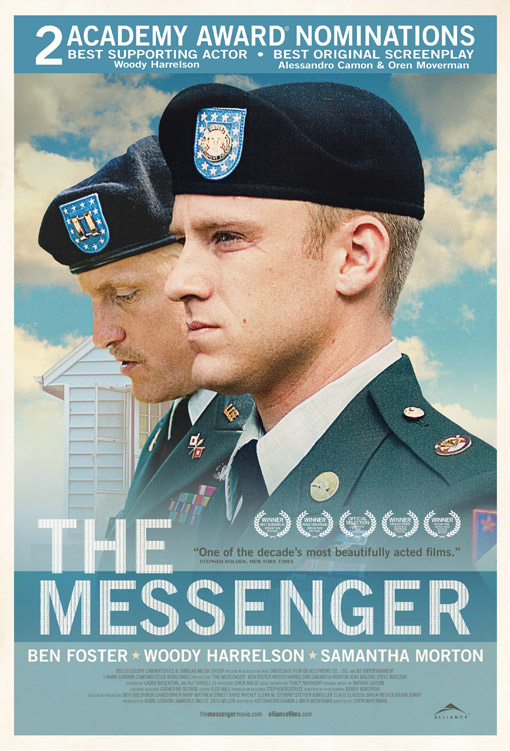
Oren Moverman On The Messenger

Oren Moverman established himself as one of America's most exciting and individual screenwriters by working on films such as Todd Haynes' convention-breaking Bob Dylan biopic, I'm Not There, and Alison Maclean's Jesus' Son. But it wasn't supposed to be that way.

After serving in the Israeli Defence Force in Lebanon and the Occupied Territories, Moverman moved to New York in 1988 planning to become a director. He studied cinema at Brooklyn College, and with help from an American documentarian he'd met in 1985, while patrolling in Hebron, secured a job with cinema legend Al Maysles (Gimme Shelter).

He was all set to make his directorial debut in 2000 with the self-penned thriller, This Side of the Looking Glass. But just three days before the start of filming, the funding fell apart and the project collapsed. Moverman sent his unfilmed script out as a work sample, and suddenly found himself in demand as a screenwriter. When he did eventually get to direct his first feature, The Messenger, it was less out of choice than because he'd exhausted most other options.

Written by Moverman and a fellow immigrant, the Italian Alessandro Camon, the script about two US Army Casualty Notification Officers (Ben Foster, Woody Harrelson) grappling with their personal demons as they perform the duty of informing families that their loved ones have been killed in Iraq, was circled by Sydney Pollack, Roger Michell and Ben Affleck, who at the time was looking for a follow-up to his directorial debut, Gone Baby Gone. For an assortment of creative and scheduling reasons, things never worked out. “So I was the last man standing,” says Moverman wryly.

Given that a raft of Iraq war dramas from Nick Broomfield, Paul Haggis and Brian De Palma were released in 2007, with Kimberly Peirce's Stop-Loss and Kathryn Bigelow's Oscar-winning The Hurt Locker appearing the following year, Moverman's film, like Ken Loach's recent Route Irish, looks at first sight to have arrived in the UK somewhat late in the day.

Even so, the Iraq war is far from old news and clearly there are still fresh angles from which to view it. Loach, for example, looked at the privatisation of the war - something he believes would not have been possible if he had made his film earlier - as well as the emotional and psychological effects experienced by many returning soldiers (part of the so-called PTSD time bomb).

Moverman, meanwhile, shows the damage done not only to men engaged directly in the conflict, but also to the people at home whose nightmare begins with a knock at the door. A quiet, reflective film, The Messenger mines a side of war that most Americans (or people in the UK, for that matter) don't really see.

In Israel the entire population has a connection with the consequences of war because the IDF is a “people's army”, says Moverman. Indeed, he remembers watching his father leave to fight in the Yom Kippur War when he was growing up, and knew from a young age about the teams that would arrive at a family's home when someone had died.

In America, on the other hand, the voluntary nature of military service means only a small percentage of the population have their lives touched directly by the wars in Iraq and Afghanistan. For most people, death is kept at a distance. In fact, until 2009 the media were banned from photographing coffins draped in the Stars and Stripes arriving at Dover Air Force Base, Delaware. While in 2004, Ted Koppel found himself accused of being unpatriotic when he respectfully read out the names of the fallen on an edition of ABC's Nightline. The Messenger was released in America just as the mood was starting to change. Nevertheless, Moverman insists that he didn't want to make a political film.

"That would have been the easy way in,” he says, “and probably the thing that would finish it off. Once you go into politics and argument, you go into emotions, and emotions take you outside of rational conversation when it comes to facts, and then you can dismiss the other side. We wanted a movie that could actually be very gentle and pull people into a dialogue.”
 
Moverman  didn't replicate his own experiences in the film, although the soldiers' "emotional landscape" is similar, he says. He feels close to Foster's character, who is filled with guilt and anger and desperate to reconnect with ordinary folk, but working in a context where people pride themselves on their ability not to show emotion. “You're a soldier. You're a tough guy," Moverman told his friend and fellow filmmaker, Ira Sachs. "There was no room for emotion, but those things start getting very confusing. I was a guy who came home from the army for a two-day leave and locked himself in a room and watched Apocalypse Now over and over again - in the dark. I was that guy.”

The former IDF soldier Ari Folman achieved some catharsis by dealing with his personal experiences during the first Lebanon war in the animated documentary Waltz with Bashir, while Samuel Maoz drew from his time as part of a tank crew in the unnerving and claustrophobic Lebanon. Moverman isn't about to do anything similar, though. “I don't have the kind of military experience I feel needs to be explored on screen," he says matter of factly. "I actually don't think I'm that interesting.” Asked if he saw any action like the other two filmmakers, he pauses for a moment. “I was in Lebanon [after the war] and the first Intifada. I don't know if you'd call it action but it's definitely politically tense situations, both having to do with occupation, just like in Iraq – but very different. It almost seems romantic now, compared to what's going on in the world today.”

He still has family in Israel. “I worry about that place every day. It's beyond tragic and I don't see the [Israeli-Palestinean conflict] getting resolved any time soon. It's sad. We know what the future's going to be: it's either going to be horrifying and terrible, or it's going to be two states living side by side and sharing Jerusalem and making it an international city. The question is: how many people are going to die on the way?”

As for Moverman's own future, his filmmaking career in the States is going from strength to strength. On the back of The Messenger and its two Oscar nominations – for Harrelson and the film's screenplay – he has written (in collaboration with James Ellroy) and directed a second feature, Rampart, based on a real-life case of corruption in the LAPD, again starring Harrelson and Foster, while Steve Buscemi is lined up to direct his adaptation of William Burroughs' semi-autobiographical novella, Queer.

“It's one of my favourite scripts,” Moverman says excitedly. “It's about Burroughs in Mexico City and also it's a story about becoming a writer, and becoming a writer out of a need to tell stories. He can't really express his emotions so he creates these stories that express the emotions for him.”

Sounds like another one from the heart.


The Messenger is released today

* An edited version of this story appeared in The Scotsman, 16/06/11

Wednesday

Helen Mirren: An audience with The Queen


Ahead of the Oscars, double Golden Globe-winner Helen Mirren talks about her award-winning performances as Elizabeth I and Elizabeth II.
Venice, September 2006


As a young woman you were always very anti-establishment. Now you’re not only playing the ultimate establishment figure, but you’re also a Dame. Do you now feel like you have become the establishment?

“That’s my great fear. I don’t want to be a part of the establishment as such. That’s not my role as an artist. You have to hold yourself apart because our job, as artists, is not to arbitrarily attack the establishment, I don’t say that, but if that need comes to step up and do it. You have to kind of hold yourself apart. But as you get older, inevitably life [smiles] pulls you into it because the younger generation look at you that way. You become the establishment just because you are established, and the younger generation are going, ‘Yeuch, get rid of them.’”

Have you ever met the Queen?

“I met the Queen very briefly, for about 20 seconds, at a polo match - the first and last polo match I’ve ever been to. I was invited to have tea with the Queen, with about a thousand other people, and me and Chloe Sevigney were taken over to meet her. I had the impression that everybody has when they are meeting the Queen in a slightly informal situation: she is absolutely charming and very twinkly and very easy and very natural. I did use that in the beginning of the film, before the tragedy of Diana’s death, to show this person with a sense of humour and kind of ease about her.”

Did she know that you wanted to play her?

“She did because I wrote to her. I got an answer from her secretary saying, ‘The Queen has read your letter with interest.’”

What did you write?

“I said, ‘I’m sure you’re aware that a film is going to be made and I am playing your Royal Highness. I understand that this is intrusive, especially as the film deals with these very difficult two weeks.’ This is more or less, not verbatim. I’d already done a lot of research at that point, so I already had a feeling. Through my research I had this growing feeling of respect for her. So, I just said, ‘All I can say is that I will do this as honestly as I possibly can and try and reflect the person that I have come to respect.’”

When you looked at yourself in the mirror, dressed up, did you think, ‘Oh my God, I really look like her’?

“Yes, I used to take myself a little bit by surprise. But I really looked like her when I was acting her. I didn’t particularly look like her when I was just being myself. It was when I took on the character and my head went back and the look came that I started looking like her. So when I looked at myself in the mirror, I’d think, ‘I don’t look anything like the Queen. I look like Helen Mirren in a wig.’”

Was there any intention in the film to reflect on where Blair is today because he seems to be in the position now that the Queen was then?

“Indeed. Although I have to say when we started the movie, it wasn’t quite as extreme as it is now. And I love that line, ‘This will happen to you, Mr Blair. And it will come quite suddenly.’ That’s very much Peter [Morgan screenwriter].”

Do you think Blair admired her power because it’s as if he has also now become monolithic, distant and deaf to the public?

“You know, I can’t say anything. That’s maybe what you want to say. I have no idea.”

But you’re a Labour supporter and during the election in 1997 you were vocal in your support.

“Well, I was a supporter of change. And Blair was a wonderful, and he still is, orator, and a great politician. No question. All the resources that a politician is supposed to have, he’s got - including an ability to dissimilate [Laughs]. He’s a brilliant politician. It was time for change, so might as well be him.”

What research did you do to play the Queen?

“I had just done Elizabeth I in Lithuania, I was exhausted from that, but I had to go to the South of France. I went with this big bag of tapes and I spent my whole time just watching tapes and reading biographies. One that I found really, really valuable in particular was the book that was written by Elizabeth and Margaret’s nanny, Crawfie [Marion Crawford]. She had them from about the age of five, even younger, and she was with them through the abdication of their uncle, through their father becoming King, the move to Buckingham Palace. When the girls got to be 16, 17, 18, whatever, she was let go, because she no longer had a job. She wrote this book and it was terrible. The monarchy saw it as the most appalling betrayal, because it was the first time they’d ever confronted anyone going public about what happened in the private life of the royal family. In fact the book is very, very sympathetic, totally uncritical. But it really does show the world that they lived in and she does talk about Elizabeth’s character as a young girl. I found that book totally invaluable because I found myself gravitating very much towards Elizabeth before she became Queen, really up to the end of the Second World War. It wasn’t like she was born and this is going to be the next Queen. Her uncle was King and if her uncle had children there was no way she was going to be Queen. And even when her father became King, her mother and father were young enough to have more children. So if they’d had another child and it had been a boy, she would not have been Queen. So for a lot of her young life she lived without that understanding and that was the person I wanted to look at. Get that Queen thing away from her and just look at the little girl.”

Did you see any similarities between the two Elizabeths?

“Well, I think monarchs have to believe that God wants them there and they are, in general, God fearing or religious. I think if they don’t believe that God wants them there, the whole thing falls apart a bit. And, you know, there’s this thing of how ego plays out within the role of monarchy. In Elizabeth I’s case the ego was so enormous it was incomprehensible. It was like an Everest of ego. And Elizabeth II, there is no ego. It’s very strange. It’s as if she’s let go of ego. It’s like when you pass through vanity, through ego, into another place, which is the place of no choice. I can’t comprehend what that must be like.”

Would you compare her with an actor that has to play the same role throughout her career?

“No, it’s way beyond acting. It’s being, not acting. And I do know that the Queen has an absolute abhorrence of performing. She finds it, and always has, very difficult to, you know, smile the way actors do on the red carpet. Smile and wave. She’s not good at that. And I don’t think she sees it particularly as her role to act. She is being. It’s a far deeper than acting.”

The Queen deals with her grief by putting her energies into the grandchildren. Did anything in your own experience inform the way you played these moments?

“Not really because I’ve never experienced anything like that. I mean I can understand from a human point of view that of course your energy would go towards protecting your grandchildren, especially in a world that wants more anything to eat those children alive. What the public wanted was Harry and William to come out and fall on their knees and sob and say, ‘My mother! I’ve lost my beautiful mother!’ They wanted that photo opportunity. It was disgusting. Some people to this day say, ‘Why didn’t they cry?’ You know, fuck off. I say beware of people crying on television. These guys who come on and cry about their wives missing, usually they’re the ones who have killed them. Why do people think crying in public is a sign of emotion? It’s very often a sign of lying.”

What is your interpretation of the scene where the Queen goes to look at the killed stag?

“That was a scene in the script that I loved the most and I thought really heightened it into being more than documentary, more than a cheeky look behind curtains. It gave it a poetic quality. I think everyone who sees that sees their own symbolism. I know that Jamie Cornwall, who plays the Duke of Edinburgh, absolutely saw that as Diana. Saw the death of the stag as the death of Diana. This magnificent wild creature cruelly killed. I didn’t see that at all. My interpretation was that it’s the loss of a generation and a way of life. Not of a monarchist way of life but a way of Britain being. I felt like that because I felt like that when my mother died. What killed me was the loss of that generation. We are losing that generation who experienced the depression, the Second World War, the deprivations of the post war in Britain, and then presented my generation with a National Health System, with an education system that allowed me, a girl from a working class economic background, to have a college education, and gave us this incredible modern world.”

How important to you was becoming a Dame?

“Becoming a Dame was to do with my family, with my Mum and Dad, and the world that I grew up in. They were both dead by the time, and that’s the sadness in getting something like that - usually you’re much older and your parents are dead. But I accepted it for my parents.”

It’s the 25th anniversary of The Long Good Friday this year. Bob Hoskins said he was always embraced somewhat by the underworld after appearing in that film. Was it the same for you?

“Well certainly in the East End, yes. In fact, my mother’s side of the family did come from the East End and, actually, I had had an uncle, not a blood relative but an uncle by marriage, who was an East End gangster. So I had had tenuous connections with that world [laughs] anyway. But certainly for a long time afterwards - it’s only just dissipated - I had incredible credibility in the East End. Any East End pub I went to into, any taxi driver, I had great, great cred. It was great. But I’m not saying they were necessarily gangsters, they were just East End people.”

One of your relatives used to be the butcher to Queen Victoria, didn’t he?

“Yeah, my mother’s grandfather was a butcher, so they came from that East End. I didn’t know a lot about my mother’s side of the family, actually, until quite recently. A journalist, needless to say, investigated it, unbeknownst to me, and did a whole thing on it. I knew that my family came from the East End but then I discovered that actually we came from West Ham. It was brilliant. I actually sent him a letter saying, ‘Thank you. That was great.’ He sent me all the research material.’”

So, you’ve played the Queen. What now? What about a very sexy role?

“[Laughs] Well I just did do a rather sexy film called Shadowboxer. I get to make love with Cuba Gooding Jr. It was fabulous.”

That’s a dark, violent film. What attracted you to it?

“It was the director, he persuaded me. Lee Daniels [producer of Monster’s Ball and The Woodsman]. He calls it a homo-ghetto-euro-movie, because he’s very gay and very black. So, you know, I thought it would be cool to do a movie with a gay black director. And it was fantastic. Macy Gray was in it, Mo'Nique - so I was in this wonderful American black world that was just fantastic.”


© Stephen Applebaum, 2007