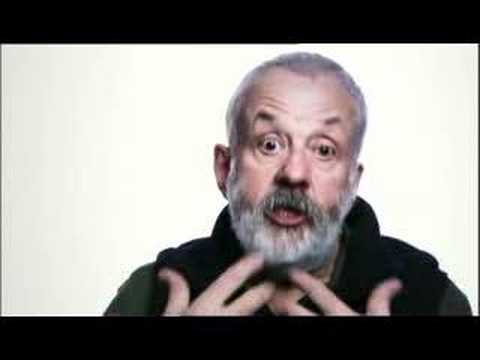
Mike Leigh may be a staunch anti-Zionist but much of his work is ‘inescapably Jewish’, he claims
By Stephen Applebaum, November 4, 2010
So much dust was kicked up by Mike Leigh's recent decision to cancel a cultural visit to Jerusalem and the West Bank that it almost obscured the fact that the outspoken veteran of stage and cinema has a new film out this week - and arguably one of his best, at that.
Another Year is like the hangover from Leigh's uncharacteristically upbeat 2008 comedy, Happy-Go-Lucky. Where that film was filled with a youthful joie de vivre, thanks to its positivist singleton protagonist, Poppy (Sally Hawkins), the new film taps a gloomier vein of middle-age angst. Leigh himself regards Another Year as no less "life-affirming", though he admits that "it does deal, in a more obvious way, with what we may call deeper and darker things".
Set over the course of a year, the film follows a group of family and friends revolving around a happily married, late middle-aged couple, Tom (Jim Broadbent) and Gerri (Ruth Sheen). While their lives seem sorted, some of the people in their orbit, in particular Gerri's desperately lonely fifty-something work colleague, Mary (Lesley Manville), are barely coping.
As usual, Leigh, who grew up the son of a doctor in what he calls
the "north Manchester Jewish scene" in the '50s, serves up tears and
laughter in Another Year - a characteristic of his work which he
describes as "inescapably Jewish".
There's always two sides to a thing — in that sense there's a Jewish spirit in my work
"Inescapable"
is an interesting choice of word, since Leigh long ago turned his back
on Jewish life, in between returning from a trip to Israel with the
Zionist youth group Habonim as a teenager, and enrolling at RADA to
study acting.And he is keen to make something clear about that period of his life. While he was in Habonim, "I was never a kibbutznik or anything," he says. "I was just a kid, you know? I went on their very nice, wonderful Israel camp, supported by the Jewish agency, and the idea was to make us go and be kibbutzniks. Indeed some people did, and I still know people at a couple of kibbutzim, that go back all that way. But I walked away from the whole thing because I was sceptical, and have become more so really."
Yet he believes his funny-sad aesthetic proves that the ties to his Jewish roots still bind. "It's not something I do consciously or I think about," he says, "but it is nevertheless a fact. The films are comic and tragic, there's always two sides to a thing, and all of that - in that sense there's a Jewish spirit in my work."
This, perhaps, explains why he makes "films - and sometimes does plays - which are never concerned with general political statements or simplistic analyses or propagandist conclusions. That's not what I'm concerned with," he says. "I'm concerned with humanity and compassion and life as we live it, and all that sort of thing."
His works observe life, and the human condition, from different angles, without telling the viewer what to think. For instance, Tom and Gerri's relationship with Mary raises a number of questions about the limits of friendship, without actually answering any of them. Are the couple helping her or unwittingly preventing her from moving on with her life? Another Year does not tell us, because Leigh probably does not know himself.
Famous for building his films through a protracted process of improvisation with his actors, who only know what their own character knows, the director says: "I embark on a journey, always, and Another Year is no exception, and that journey is a journey of discovery as to what the film is."
In the way that they are made, and the way that they play out on screen, Leigh believes his films embrace the "spirit of Talmudic study". "I'm inviting you, my audience, to sit round the table and for us to say: 'Maybe it's this. Maybe it's that. We don't know'. Which is a Talmudic investigation that doesn't arrive at any conclusions, basically."
Indeed, the central subject of Another Year is ageing and what comes with it; how life, says the 67-year-old director, "becomes at the same time clearer and more complicated. The film is about how we come to terms with life, really, and face ourselves and each other." Leigh offers no answers, of course, and he is uncomfortable with the suggestion that the film focuses on the pursuit of happiness and how, as we get older, we are forced to look for it inside ourselves.
"That may be true and it may not," he grins. "I don't know about it because we are all products of our background and victims of stuff that has happened to us. Yet there's talk in the film that you have to take responsibility. Mary is a victim of bad things - relationships, abuse, etc - but on the other hand, you can plainly say she's only got herself to blame. Then again, if she's an alcoholic, why does she need that? Also, you can see she's a woman that's spent a lifetime saddled with the received notion of being sexy, of being feminine. That comes from what's been fed to her. You see her hanging on to that, but it's desperate."
This understanding of the intimate relationship between past and present, and the need to look at the complete picture, is there, too, when Leigh talks about Israel - and may have had some bearing on his recent decision to cancel his visit. He does not dispute the connection between the Holocaust and the creation of the State of Israel, but says that he and his "old haverim from way back" often "ruminate about how we never knew Palestinians were evicted from the properties and everything that goes with that. It was denied to us," he claims.
"We were never, ever, really focussed on the fact that they actually were people with roots and a place and they weren't just generic Arabs. You still hear that now: 'It's their fault'. And the fact is now you've actually bred generations of resentful Palestinians. In the end people may say it's an insoluble situation. Well, that's a tragedy."
Leigh had his artistic say on the subject in 2005, in the play Two Thousand Years. He is now about to return to the theatre with a revival of his 1979 play, Ecstasy, at the Hampstead Theatre. He will also put on a new play at the National Theatre. As usual, the project is draped in secrecy. "I can't say anything about it," he smiles, "except that it's extremely unlikely it will be a further investigation into matters of a Zionist nature."
Mike Leigh returns to Cannes next month with Mr Turner
First published in The Jewish Chronicle, November 4, 2010