Translate

Showing posts with label Reese Witherspoon. Show all posts

Sunday

Murder Most Mysterious

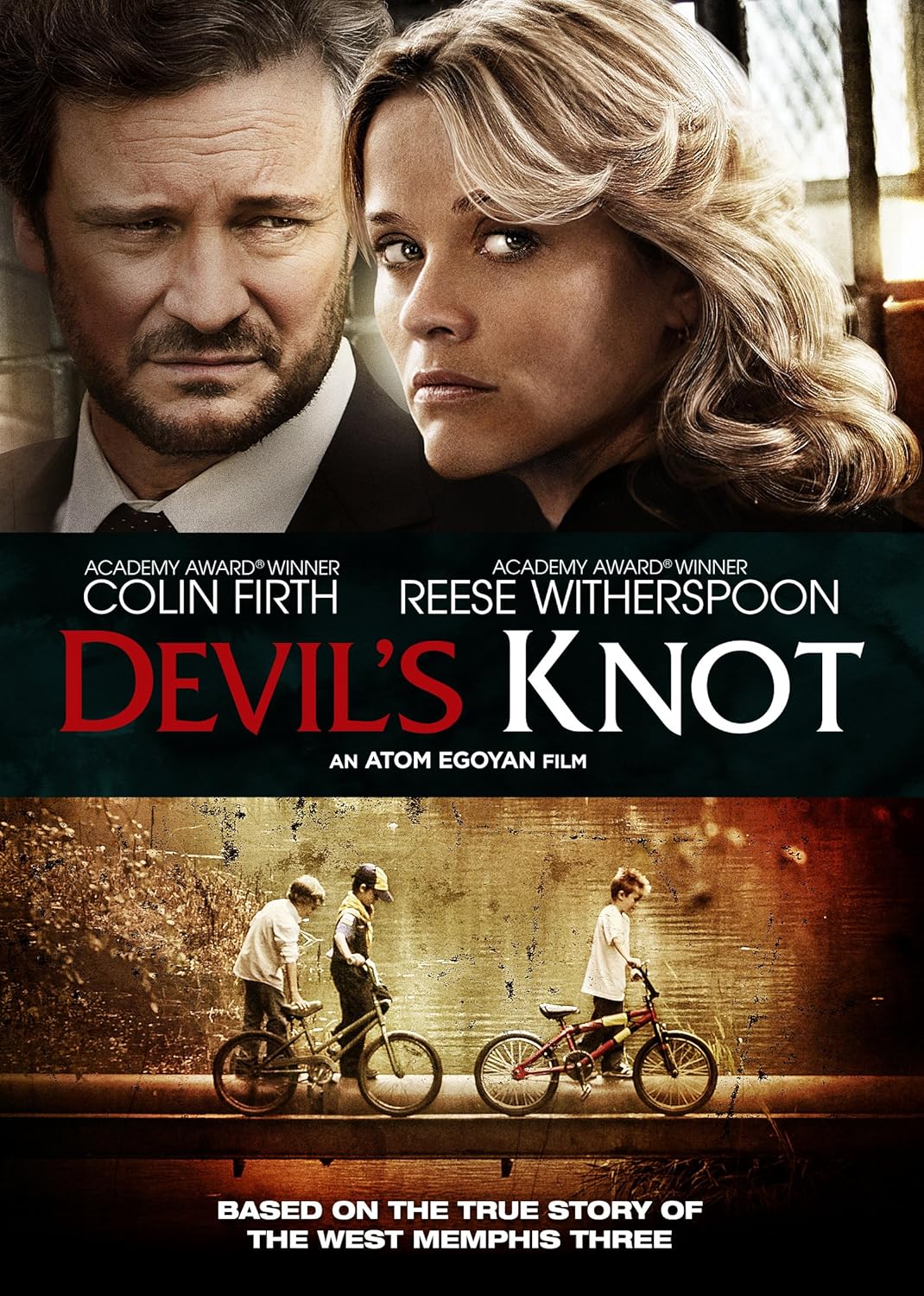
Atom Egoyan explores the case of the West Memphis Three in Devil's Knot

Canadian filmmaker Atom Egoyan didn't know what he was letting himself in for when he decided to make a dramatised account of the West Memphis Three case.

It had been explored from different angles before - most notably in a trio of acclaimed documentaries by co-directors Joe Berlinger and Bruce Sinofsky, and another by Amy J. Berg - but Egoyan felt the story of the latter-day "Salem witch hunt" in a small, deeply religious neighbourhood known as Robin Hood Hills in West Memphis, Arkansas, following the horrific discovery of the bodies of three missing eight-year-old boys, bore retelling.

The director was, therefore, surprised when his film based on Mara Leveritt's book, Devil's Knot, and starring Colin Firth and Reese Witherspoon, was panned by North American critics after its world premiere at the Toronto International Film Festival last September. Speaking a few weeks later at the Zurich Film Festival, he's still angry about what happened in Canada, if somewhat buoyed by the film's warmer reception in Europe.

 So what went wrong?

"There were a few critics that were prepared to engage with the film and to take it seriously, but for the most part there was this kind of dismissal because they already knew the story," he says.
"There is a kind of elitism where they don't understand that this is a very powerful story that deserves re-investigation, and that there are a lot of people who might go and see a film with Colin Firth and Reese Witherspoon who would not see a documentary. So when they say, 'Watch the documentaries', I don't think that's really responsible."

For Egoyan, the tale of the West Memphis Three isn't just another murder story, but "one of the most extraordinary pieces of mythology in contemporary American culture".
Three teenagers - Damien Echols, Jessie Misskelley Jnr and Jason Baldwin - were convicted of the killings. They were released after 18 years in jail - a rare deal negotiated with the state of Arkansas set them free, though they remain convicted felons - and to this day, no one knows for sure what happened on May 5, 1993.

Egoyan's film feels haunted by the young victims - Stevie Branch, Christopher Byers and Michael Moore - whom, he agrees, have sometimes been squeezed out of the frame by the tight focus put on the plight of the supposed killers. The boys' fate, though, is the mysterious heart of the story: they went out to play in the woods together, and no one - except for their murderer(s) - saw them alive again.

"Something happened that was so unimaginable," says Egoyan. "These three boys went into this forest and the next day their naked, mutilated bodies are found, tied with their shoelaces, submerged in the water, with absolutely no evidence. No DNA. No blood. No footprints. No branches moved. It's eerie, and it is supernatural. It is the stuff of mythology. You couldn't create that."

The subsequent police investigation, arrests and trials (Misskelley was tried separately because he had confessed) took place amid a "Satanic panic", making Echols - a young Goth interested in witchcraft and heavy metal music, and, significantly, the only one of the three suspects to be sentenced to death - a particularly easy target for a police force and community desperate for answers.

"He was an outsider and didn't understand - or he wasn't coached properly - that one of his roles playing a defendant is to feel innocent," says Egoyan. "He never did. It's quite odd. He maintained his outsider role and actually seemed to revel in it."

In the film, Ron Lax (Firth), a private investigator working for the defence, and Pam Hobbs (Witherspoon), the mother of Stevie Branch, both initially believe that all of the suspects are guilty. However, their certainty becomes eroded by doubt, and they are left despairingly adrift in a sea of confusion. "The real question I wanted to deal with in this film is the notion of powerlessness," Egoyan says.

"It's a very different point of view to a documentary. A documentary is about pointing a finger and saying, 'Go after this person'. I'm not interested in that. I'm interested in this idea of bringing the viewer into a place where you want something to resolve, but it doesn't. And that is ultimately the Devil's Knot. The more you try to undo it, the tighter it gets."

Though he didn't write the screenplay, and Devil's Knot is his first feature based on a true story, it fits neatly into an oeuvre that frequently includes characters seeking the truth, or who construct false realities to cope with their lives, or are wrestling with questions of guilt and responsibility.

Asked why these themes and ideas keep recurring in his work, the filmmaker says that it comes partly from growing up as the son of Armenians, 1.5 million of whom were killed by the Ottoman government in the Armenian genocide of 1915, although Turkey still refuses to recognise the event.

"You're dealing with the fact that there's this cataclysmic historic event which you're taught is an absolute reality, but which is denied," says Egoyan, who explored the genocide and its legacy in his controversial 2002 film, Ararat. "So you're often in these bizarre conversations and that becomes a part of your formation - I mean to this day - I suppose. So there is that political aspect of it, which is just part of one's upbringing."

On a more personal level, he says he had a "strange experience" where the "young woman I was completely obsessed with, for like five years, during my teen years, was being abused by her father at the same time. I understood that there was something creepy and unusual about it, but she was in denial and, certainly at that time, no one was talking about those issues," the filmmaker says.

"So I think the combination of those two things in my life - the one which is kind of a grand, familial communal tale and this personal one - have had a very strong effect on me," he surmises.

Egoyan isn't optimistic about the real killers ever being brought to book. Pam Hobbs once suggested that Terry Hobbs, her ex-husband and Stevie's stepfather - a man with a history of violence and a strand of whose hair was found in the shoelace binding Michael Moore - might have been involved in the murders. She was on set almost every day and Egoyan says that they had what were often "odd conversations".

"The film doesn't really address this but [Terry] is still in her life. And it's the oddest relationship," the director says.

"He is a dark, malevolent man. But just because he abused his daughter, just because he had violent outbursts, just because he had this dark personality, it doesn't mean he could have done it.

"This is the thing about the crime. The more you look into it, the more impossible it is."

Originally published in The South China Morning Post, May 27, 2014

Friday

Jonathan Holiff: My Father and the Man in Black

Jonathan Holiff recalls the journey that led him to the truth about his overbearing father, Saul: the man who struggled to control Johnny Cash and his own demons.

Jonathan Holiff wanted to forget his father, Saul, after he committed “rational suicide” in 2005. They'd been estranged for decades, and Jonathan only had painful memories of the hard-drinking man whose coldness blighted his youth. He'd left Canada, aged 17, determined to earn his showbiz father's respect by bettering him professionally. Despite doing well in Hollywood, none came.

[My] entire adult life had been a knee-jerk adolescent reaction to my father's lack of approval,” Holiff says down the line during a visit to Los Angeles. “So I realised, after his death, that I was truly unhappy, and no longer had an interest in the superficial existence that I had pursued and embraced as a consequence.”

He sold his business in Tinseltown and drove back to Canada, thinking he'd also left Saul behind. However, as revealed in his compelling documentary, My Father and the Man in Black, Holiff was in fact beginning a journey that would force him to re-think his father.

Looming over their story is Johnny Cash, the Southern Baptist superstar Saul - a Jew “as serious as a heart attack”, according to band mates - managed for 13 years, before mysteriously quitting at the height of Cash's fame. When journalists and biographers started calling with questions about Saul and Johnny's relationship that Holiff couldn't answer, his mother remembered that after retiring, her husband had put his business things into a storage locker.

I was unable to bring myself to open the door because I didn't want to wade into my father's life,” says Holiff. “I was still un-evolved emotionally. I was still practising denial.”

Two months after his return, Walk the Line, starring Joaquin Phoenix as Cash and Reese Witherspoon as June Carter, his singing partner and second wife, opened, and people wanted to know what Holiff thought of the glossy biopic. “It seemed almost as if I was being punished at first, and certainly seemed like a conspiracy of some kind,” he recalls wryly. Nevertheless, he reluctantly went along to the cinema, and although Saul was erased from the film's “whitewashed” storyline, it was eye-opening.

I was so unfamiliar with the specifics of my father's career that not only did I not know that it was Saul who hired June and put her with Johnny professionally, I hadn't realised that Johnny was famously arrested [on drug smuggling charges in El Paso] the year I was born. When I saw that I failed to really watch the rest of the movie, because it opened a floodgate of repressed or forgotten memories of childhood.”

Holiff decided to face the storage locker. “I wanted to find out if there was anything about his children among his most important documents and archives. And the answer was, no.”

What he did find was life changing. Among Saul's belongings – which included a gold record awarded to him personally for a million-plus sales of A Boy Named Sue – were more than 60 hours' worth of intimate audio-diaries and recorded telephone conversations between Saul and Johnny. As a child, Holiff knew Cash as a “very special and kind and generous” man. Now he discovered a young, pill-popping rebel nicknamed Johnny “No-Show” Cash whom Saul struggled to manage. (He missed an entire tour just before Holiff was born, leaving Saul – as he so often would - to pick up the pieces, and worrying about money.) The filmmaker also learned that when he was nine months old, he was on the road with Cash in Toronto, in 1966, when the singer “overdosed and nearly died, and we all drove to Rochester across the border, risking arrest for the discovery of pills [hidden somewhere] in the motor-home.”

Holiff had never understood before why Saul had treated him and his brother like clients, including making them sign contracts, while they were growing up. “I realised that [Saul] was dealing with a very volatile character in Johnny Cash . . . who was very much like a wild child, and he perhaps [tried] to control us from the beginning and mould us into what he expected from his children.” Holiff rebelled, though, “much like Johnny Cash did, only not quite as famously and spectacularly.”

Walk the Line suggested that Cash gave up drugs - he didn't. The film also failed to address his becoming Born Again.

Jonathan always wondered why his father had flown into a rage when he came home from school, aged eight, and declared that he wanted to be known as John. “He absolutely blew up, and I thought he was going to physically kill me and take me apart. He said, 'Your name is not John, it's Jonathan. John is a Christian name and you shall not use it.'” Going through Saul's files, he realised that this was around the same time that another John – Johnny was Cash's stage name - was trying to convert his father to Christianity.

In a recording about his childhood, his father says he grew up surrounded by almost “palpable anti-Semitism.” Nonetheless, he remained proud of and open about his Jewish identity. One of Holiff's more surprising finds, therefore, was a photograph of Saul as Caiaphas – the Jewish High Priest supposedly involved in the plot against Jesus – in Cash's self-funded film shot in Israel about the life of Christ, The Gospel Road. Saul had never discussed it afterwards, not even with his wife.

“The conclusion we drew was that he quickly regretted having done it and it was a source of pain for him for many years,” says Holiff. In one of the actual excerpts from Saul's audio-diaries used in the film, he asserts of Cash: “He robbed me of my soul and now I think he's trying to save it for me with his fundamentalist Christianity jazz.” Not long after, he resigned.

I think he woke up and realised just how far he'd gone without perhaps even realising what he was doing,” Holiff suggests. “So I think that's the straw that broke the camel's back in their relationship.”

Listening to Saul's self-lacerating and self-aware recordings, his expressions of guilt over not being a better father, and disclosures about his own troubled upbringing, Holiff came to see Saul as a three-dimensional human being for the first time. Has he forgiven him?

Here is a guy who was wealthy, successful, had stature, was working with the biggest-selling recording artist in the world in 1970 - Johnny exceeded The Beatles' sales in the United States, briefly, in 1969 - and he never found happiness. So I was very forgiving of him.

Copyright Stephen Applebaum, 2013