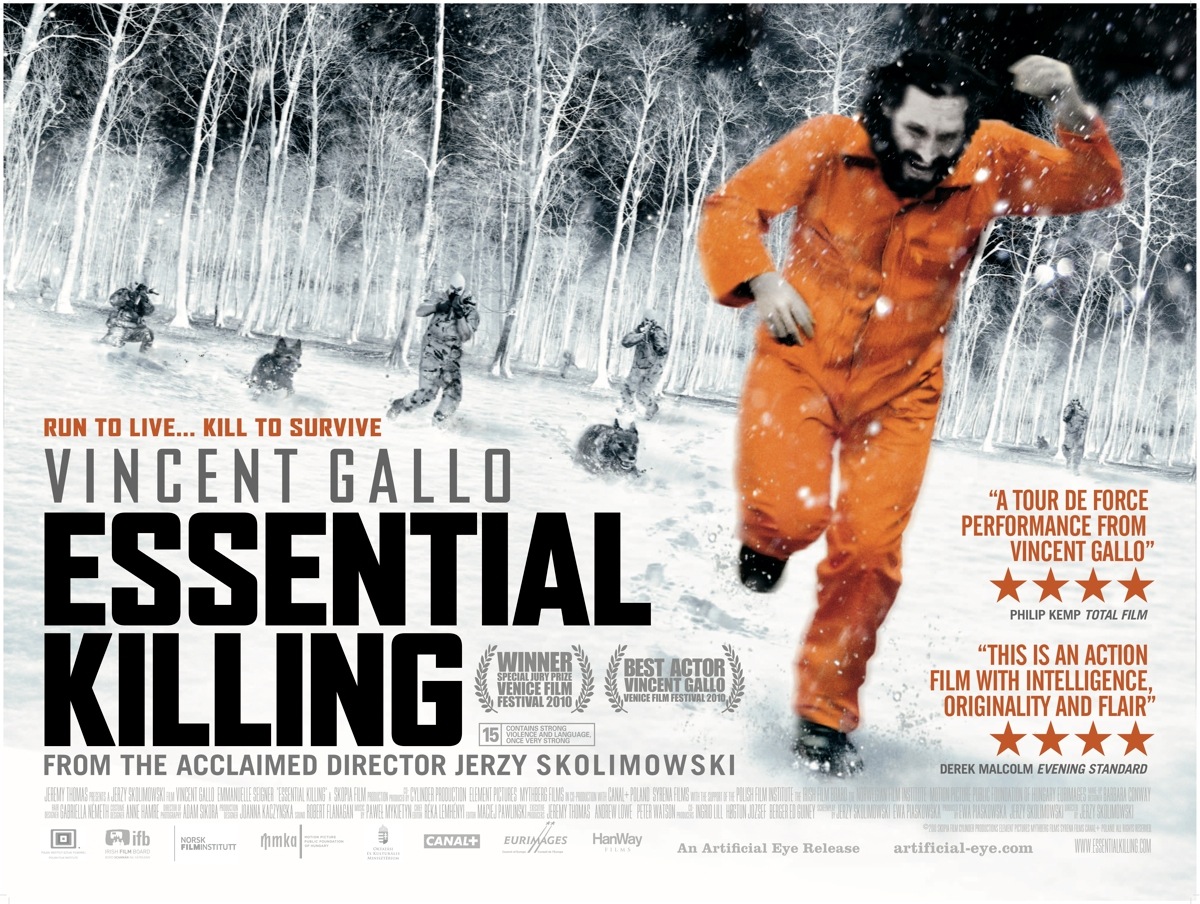
Essential Killing is an outdoor survival movie filmed in several countries, but it actually began with you wanting to make a film near your hunting lodge home in Poland, right?
“Yes. When I decided to sell the house in California, and decided to move back to Poland, I chose not to live in town anymore. I bought a 19th Century hunting lodge in the middle of the forest in Masuria, which is the area that before the Second World War was East Prussia, German territory. So the hunting lodge is solidly built by Germans and it will survive, maybe, another hundred years. Anyway, I made my last movie, Four Nights with Anna, literally around my house, and it was very comnfortable because I didn't need to go to any locations. I was staying in my own place, not hotels, and that was fine with me. So after I finished it I said, 'Well, it would be good to repeat that formula. But what can I do in the forest again?'”
Yet you actually went quite a way from your home in the end.
“Yeah, the picture became much larger than I thought it was going to be. Eventually I wasn't shooting at all in my house because we were shooting in Norway, we were shooting in some other parts of Poland, and Israel. So the initial idea which pushed me to do it [laughs] is no longer there. ”
You mention a CIA rendition operation taking place nearby in the press notes. Was that your starting point?
“I knew about that CIA operation because this secret military airstrip is literally 20 kilometres from my house. But I thought, 'Well, this isn't a subject for me. This is heavily political. I don't want to touch it.' I don't have an opinion on that subject at all, so I couldn't express whom I feel is right, who is wrong.”
You haven't shied away from politics in the past, though.
“No, I was practically expelled from my country after I made a very political film called Hands Up!, which burned my fingers forever. I was happily settled in Poland at that time. Then I made this heavy, anti-Stalinist movie, and my life changed because they said this film will be never shown and you must go out of the country. I was pushed away from home and I had to find some place to live. So this is why I didn't want to touch the political subject of Essential Killing.”
So how did the story develop?
“One Winter night I was driving back home, and the road was so slippery that although I have a four-wheel drive car, I suddenly started to slip, nearly going down this slope. It was a scary moment. I thought, 'If this miltary convoy goes like this on the same road, and, for example, a group of animals, which I see on those roads many times, is just crossing, and the first car stops, the next one bumps into it and slides down, this is a very realistic, quite probable possibility that the wagon would roll down, the doors open, the guys would be thrown out, and someone can escape.”
And that changed things?
“Yes. I said from this moment it starts to be my film subject. There won't be any politics anymore, but here is this guy, in the middle of nowhere, he doesn't know where he is, he's barefoot, there's chains and some kind of overall: that's my hero. At that moment I decided I could make this film.”
You don't tell us much about who he is but you suggest he's religious because you have a flashback featuring the Koran.
“Purposely I don't want you to know too much about him. I don't want to confirm that he's either a terrorist or he's not. It could be both ways. But I thought being Muslim he probably would have to pray quite many times, but, fortunately, because he's running he doesn't have time. So I thought that at least in his dreams there should be a touch of the religious aspect. So I looked through the Koran and I found those quotations which I've chosen. The first one says, 'It's not you who killed, it was Allah.' That's very important. Now when he's got the gun he is not killing; it's Allah.”
That's quite a provocative choice. Aren't you concerned about upsetting Muslims?
“Well this film is a multitude of provocation. I can expect some harsh reaction from Muslims, because he commits so many sins: looking at the strange woman, touching that woman. The drinking [breast] milk scene, phew, would be a hair-raising thing for Muslims. I'm ready for it.”
Did you deliberately set out to provoke?
“No, but I was aware, of course, that this is a very provocative subject in all aspects, starting with the CIA plane landing, which is still controversial. In Poland we've had three governments since that thing happened and none of them has said a single word about it. Nothing. So in Poland that would be the biggest provocation. But, on top that [laughs], there are many others.
“But please understand, the whole of the movie is a little bit of a fairy tale or a poem. It's practically pure fantasy. We all know, for example, about waterboarding, but who knows how it really looks? I had to devise my own waterboarding because there is no documentation. So it's not realistic. It's not a documentary.”
Was this why you felt free to cast a non-Muslim, Vincent Gallo, as your hero?
“When I wrote the script and originally wanted to shoot it around my house, for little money, I gave the script to my friend Jeremy Thomas, the producer with whom I made The Shout, and Jeremy said, 'Listen, this is such a good script, such a good subject, but you shouldn't be that modest and try to shoot it for peanuts just next to your house. Maybe if you find the right cast that would get you out of the arthouse ghetto.' Well that sounded quite interesting, actually. I thought, 'Maybe he's right. Maybe this is a subject which could go a little bit further than I originally thought.'”
So how did Gallo get involved?
“I'd started thinking about what Jeremy said and being in Cannes in 2009, I met by pure chance Vincent, whom I knew before from California. He was there presenting Tetro, Coppola's film, and I saw him coming from the distance and I thought, 'Oh, Vincent has got that animalistic quality.' His face is very strange. You cannot really identify precisely where the guy is from. Where he was born. He could have been born John, Joshua, Jo Jo, or whatever. He could be from anywhere. So I thought he could also pass as Afghani born, or maybe somebody who came from some other part of the world and assimilated there, grew a beard and hair. So I stopped him and I said, 'Vincent, I have a script which maybe you would like to read.' He said, 'Give it to me!' He read it at once, and two hours later he rang me and said, 'I want to do it. I am fit. I am physical. I'm from Buffalo, it's very cold there. I love to be in the cold.'”
Did he live up to his reputation of having a huge ego?
“Ah, Vincent is a special type of guy. But, when you see him in the film, I think it was worth going through all possible conflicts and through hell. He is great in the movie. I may not like him, but I have to say he's fantastic.”
How did you manage to get the Israeli army to lend you some helicopters?
“Let me keep that secret.”
But it is Israeli army stuff?
[Silence]
In The Shout, a scream has consequences. In Essential Killing, a scream has no consequences. Are you that disappointed with humanity?
“Possibly, I'm not an optimist. I don't see the world going the right way, that's for sure.”
You witnessed a lot during the war as a child. Presumably that was enough to dent your optimism if not extinguish it entirely?
“Yes, it might have killed it off for good. Sure.”
You've moved around all different countries and embraced different filmmaking styles. Was it difficult for you to become a part of different cultural movements?
“It's not easy because it leads to a kind of gypsy life. I had to move from place to place, changing countries, changing house. I stayed in California for over 20 years, but then I got fed up with it and moved back to Poland. So it's a new chapter in life. But it's not easy. It's a bit frustrating to find yourself in a new place and trying to start all over again. I don't know how many more times in my life I will do it.”
This all started with Hands Up! Given your time again, would you still make the film?
“Well at that moment I had to do it because I was involved politically. We were having this Communist regime that most people were against, obviously, and I was one of them that voiced the anger that is still there. But the question, would I have done it again? I really don't know. To me it ruined my life.”
And what about the fact that you stopped making films for such a long time? There was 17 years between 30 Door Key and Four Nights with Anna.
“I stopped making films because I made a couple of medicore films and I was very unhappy with myself. I always felt that I am a real artist. That I care about art. And those films that I made were kind of trying to be commercial but I'm not a director who's really capable of making a commercial hit. So it was unfortunate on my side and I decided to stop it. For a couple of solid years I thought I would maybe not be making films for three, maybe five years; I had to renew myself as an artist and finally got time to paint, which was a passion of my life and I never had time for it. So I started to paint.”
And how did that go?
“I started to be a successful painter. I had many exhibitions and I sold the paintings to museums and institutions and private collectors. Some of them very famous. And I fulfilled my need to establish myself as a painter. And, by the way, I paint without any compromise. I am totally honest and I only do what I really want. And that really brought me the new creative energy, so I started to be hungry for making movies. But it took 17 years.”
Essential Killing is released on DVD on Monday


