 | ||
| My review of Monster Family in City Am, 02/03/18 |
Friday


Guillermo del Toro on the deeper meaning in ‘The Shape of Water’


The film tells of a
unique love story between a mute cleaning lady played by Sally
Hawkins and an Amazonian-fish man played by Doug Jones
Guillermo del Toro is
making the biggest splash of his life with The Shape of Water. A
spin on Beauty and the Beast that could only have sprung
from the imagination of the man who made Spanish Civil War
fantasy Pan’s Labyrinth, the film has been winning
awards since taking the top prize at the Venice Film Festival
last year.
Now it is the movie to
beat at the Oscars in March, with 13 nominations. The bizarre
love story between a mute cleaning lady (Sally Hawkins) and an
Amazonian fish-man (Doug Jones) is one of Del Toro’s proudest
achievements to date. He has put his next project on hold, to
bang the drum for the film around the world.
“I made the big
mistake of finishing Devil’s Backbone [a moving ghost
story set in a Spanish orphanage] and going immediately into [vampire
action-horror movie] Blade II,” he explains.
“I have the nagging
notion that I should have promoted The Devil’s Backbone more,
because it’s still one of my favourite movies and it’s still a
movie that not many people know. And I don’t want it to happen
again.”
Read the full feature here: https://www.thenational.ae/arts-culture/film/guillermo-del-toro-on-the-deeper-meaning-in-the-shape-of-water-1.699621
Read the full feature here: https://www.thenational.ae/arts-culture/film/guillermo-del-toro-on-the-deeper-meaning-in-the-shape-of-water-1.699621
Interview: Steven Spielberg: The Post
I interviewed Hollywood legend Steven Spielberg about his new film, The Post. Read the interview here:
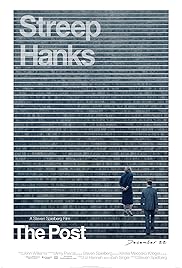
Steven Spielberg: the isolated Jewish boy who just wanted to be liked
Jewish Chronicle-18 Jan
2018
Next year he'll
celebrate 50 years as a Hollywood hotshot, this year he has two films
out. Steven Spielberg tells Stephen Applebaum how it all
started as a way of defusing antisemitism.
Monday
Amos Gitai: West Of The Jordan River

You use the same music
in this as you used in Rabin, The Last Day. Were the projects conceived
at the same time? Did they come from the same impulse? Are they
companion pieces?
"In some way,
yes."
Why now?
"Because the
situation is very bad. We have the most right wing government ever in
Israel. I think it is doing a lot of harm to the country, but I also
feel for it [Israel] a lot. There's a very narrow-minded and cynical
point of view of what it should be, and so I think to myself, 'What
can I do, I'm just a filmmaker?' So I'm doing a film."
You include a clip from
an interview you did with Rabin in which he says he won't let the
extremists derail the peace process.
"Finally they
succeeded."
So the extremists are
in power now?
"Yeah. Yeah."
There is talk of
"neo-Rabinism" in the film as something that is required.
Do you see anywhere in Israel right now where that could come from?
Are there any signs of this anywhere within Israeli society?
“Netanyahu is quite a
talented guy. He managed to mash all opposition forces. So at this
point, unfortunately, the only opposition to the current power are
these dead men. And, you know, I don't think we only have to
believe in money. Or some people believe in machine guns. I think we
also have to speak about memory, about ideas, and also memory and
ideas that move the planet, especially being a Jew. If the Jews did
not believe in ideas, they wouldn't have existed, because they were
facing much more powerful empires [in the past]. So now we seem to be
thinking that only the big jets and high-tech will protect them. But
this is a mistake. We have to speak about ideas."
I saw a documentary
about the Mossad agent Sylvia Raphael and in that a former general
said Israel needed to always be preparing for the next war because if
she loses one, that will be the end of her. Is that something that
you recognise?
"It may be true
but what does it mean to be ready? Obviously you need military power
but also if you have the wrong policy, which brought the war that I
was involved in, the Yom Kippur War, of complete hermetic,
non-negotiable positions, it's not just the jets that will help. So
with all respect to who said this, I think that it is also the lack
of the political vision, the political courage to move forward, which
I think is a necessity, that is the problem. I think what Rabin
understood is that in order to stabilise the existence of Israel in
the region, it has to find an in-road into the Arab world."
Do you think there is
some lack of understanding of the Arab mentality? An Israeli woman in
the group that brings together women who have lost people on both
sides of the conflict - Israelis and Palestinians - talks about
this.
"I don't like the
word mentality. I think that Rabin was different because he was not a
racist. He was a soldier, so when there was a war he knew how to
fight. But he didn't have a racist attitude to the other side, and
this is necessary. If you have the complex of supremacy or a racist,
or you think we are so smart and the other one not, you will never
make peace. It's not only a question of concessions or territory.
It's a question of attitude and what kind of Middle East you want."
Do you regard policies
adopted by the present Israeli government as racist?
"I think there are
a lot of racist policies, racist laws, and I think that they will
weaken Israel. They will make it more hermetic. They don't want to
teach Mahmoud Darwish [a Palestinian poet/author regarded as the
Palestinian national poet] poetry in school, and I think that is a
mistake because you're not obliged to adhere to everything he says,
but you have to know what the other side thinks. This kind of
Sovietic [sic] way of thinking about culture, about education,
intervening in the nomination of the Supreme Court by politicians,
will only weaken the institutions that Israel will need to survive in
this region. It's not such a friendly region, so you need to have
openness. You need to present a different model and not try to
integrate negative aspects of other countries of this region."
Is the way that the
Israel-Palestine conflict viewed too manichean?
"The narratives
are all wrong because I think that the conflict is not between a
group of angels and a group of bastards. I think both groups are
angels and bastards at the same time. And I think the portrayal of
some group as angelic will only prolong the conflict. I mean neither
is angelic, so let's not kid ourselves. Like I say in the film, when
Rabin gave the order to withdraw from the Palestinian cities was the
worst [period of] Palestinian suicide attacks in Tel Aviv, and
obviously that allowed the ultra right to delegitimise Rabin and
eventually to kill him. So there are no angels. Let's leave this
vision. Let's work for reconciliation and peace in a serious way, and
not like the current government is doing - just spinning some media
provocations. I think that this will create a lot of harm to Israel."
You've said young
film-makers are having to sign something for the Minister of Culture.
You seem to be an independent voice who no one's managed to tame.
Have there been any attempts to put pressure on you?
"Well the Minister
of Culture doesn't like everything that I am doing, which is her
right. But I don't ask everybody to agree with me. I also don't agree
with them, so it's fair enough. And I don't have the malady of some
of the showbiz colleagues that want to be loved by everybody. And
anyway, I don't love everybody myself. So I also think it's fair
enough. No, you know, I am just an architect to start with, and I am
into building bridges and against people who want to burn bridges all
the time. I think it's a complicated area, in a very bad historical
phase, and we have to keep trying to do it. And I think these very
courageous groups of human rights organisations, Israelis and
Palestinians, deserve all the homage and not all the curses that they
get from the Israel right wing. I think they're great."
These groups are
liberal in their thinking. What do you think of BDS?
"I'm not for
boycotts because I think we need a dialogue. And I think the
government is applying its own boycott on all these human rights
organisations, so they're not in the perfect position to speak about
boycotts. They ask that groups like Breaking the Silence are not to
speak in schools. They instructed all the schools to never allow them
to speak to young people and for a Minister of Education never to
accept it, and for a Minister of Culture to close two galleries,
private galleries, which invited them to speak out. They restrict
financing to all these groups and closed the capacity of this group
called Rabbis for Human Rights to help the Bedouins. These are pure
acts of boycott by the government. So they're not in a good position
to speak about boycotts."
With regards to the
Bedouins, is what we see in the film, with the school, a consequence
of the Land Regulation Act?
"Yes. The Land
Regulation Act is basically about trying to annex, in one way or
another, more chunks of the West Bank."
There is a lot of
mirroring that goes on throughout the film, which reflects your
earlier contention that both sides are made up of angels and
bastards.
"That's why I'm
not for boycotts because we have to keep the flow of ideas and
dialogues against the ..."
You have I think it is
three Haaretz journalists in the film.
"I think they are
great. They're, in a sense, the only independent opposition now. In a
way they are much more effective than all the parliamentary
opposition."
I think what I liked is
that you have a spectrum of views from them in the film which isn't
reflected, quite often, in the way that people sometimes talk about
the paper. Some people even say it is an enemy of Israel.
"Yeah. Yeah."
Was it intentional to
show that there is a spectrum of opinion within the paper rather than
being just a bloc?
"Sure. I think
it's very impressive that they exist."
One of them suggests
that Israel can either be a Jewish State or a democracy. Do you think
these things are mutually exclusive, that Israel can be one but not
the other?
"You know, I'm not
making direct comments on the film because I'm not for the Michael
Moore type of cinema. Even if I may agree with him politically, I
don't like this kind of documentary which is too manipulative, even
for the 'good causes'. For me it's a kind of mistrust of your
viewers. So for me, when I see these kinds of documentaries, I start
to mistrust their argument and for me it has the opposite effect. I
don't like propaganda, even from the people I agree with. I like
freethinkers. So my films are, in a way, calling for interpretation,
not consumption."
One of the interesting
things about the film, and one of its ironies, is that the way people
in it talk about the settlers we're expecting them to be foaming
extremists when we meet them at the end. But the two young women you
speak to effectively embody the spirit of Rabin. One was stabbed
and still wants to be able to live with Palestinians. Rabin talks
about reaching out to the enemy and that is exactly what she wants to
do.
"Exactly
[agreeing that they embody the spirit of Rabin]. So that's why I
think we have to collect contradictions. If we want, really, to bring
change, we have to speak to everybody. And we have to solicit forces
wherever we find them if we want to create this change and not pre
judge, and speak openly and refuse racist tendencies which are in
this current government. But also do the same judgement on
ourselves."
The settlers are often
regarded as a barrier to peace. Do you see them that way?
"Again, I'm not
going to give you my political solution unless I'm elected with a
vast majority of the Israeli people. Then I have a very clear
programme."
Would you ever run for
office?
"No."
You prefer the
independence of being a filmmaker?
"Absolutely."
West of the Jordan
River will screen at the ICA on November 23rd, followed by a Q
& A with Amos Gitai
For tickets go to
https://www.ica.art/whats-on/west-jordan-river-qa
Thursday
"I really love James Bond" - John Woo

John Woo got tired of making big budget movies and went back to his roots with the action thriller Manhunt. Expect doves, motorbikes, balletic gunplay and corny dialogue. I caught up with him at the Venice Film Festival following the film's premiere.
How
do you feel about being referred to as legendary by your fans?
"I'm
not a legend, I'm just a filmmaker. Thank you, anyway. I like film
and I'm not trying to be humble when I say I'm still a student. I
like to learn from world cinema. I can learn so many things by
watching all kinds of movies."
The
beginning and end of Manhunt
are steeped in nostalgia for classic cinema. Does this reflect how
you feel today?
"Yeah,
I like the old-time movies. 1960s and 1970s were the best years for
cinema. There were so many great masters and so many great movies,
and so many great creations - they give us so much inspiration. Now
movies seem a bit empty. I love European films, though. I think
they're much better than Hollywood."
The
original Manhunt
movie from 1976 was very serious, very masculine, and you have added
a lot of humour and two female assassins. What
was the thinking behind your version?
"Since
we couldn't get the rights to the old movie we made it from the
original novel [Hot Pursuit by Juko Nishimura]. It's got the same
storyline, but because we couldn't do anything from the old movie it
allowed us to make up some new scenes and gave us so much freedom. We
could do whatever we liked and I used it to go back to my old style.
The original movie was a little too serious; I like to make action
with more comedy."
You
do seem to be consciously looking back to your early films here,
perhaps referencing The
Killer
and Hard
Boiled.
Did you make Manhunt
for
your fans?
"For
the fans, and also for myself. I had made too many big-budget movies
and I got fed up. When a few of my big-budget movies became hits, I
became established as a big-budget film director, and I never liked
it. The more money you get the more pressure you have, and it takes
away the joy of making films. All you do is deal with the numbers,
with the budget, and it's no fun. Everybody kept saying about 'the
numbers, the numbers', and it wasn't about the shot any more. I hated
it. I wanted to go back to a much smaller kind of film and do
something like The
Killer:
a thriller. With Manhunt
I had more creative freedom to do that."
So
did you fall out of love with filmmaking for a while and need to find
a way to fall back in love with it?
"Yes,
and I did it with this film. And future projects will do the same
thing. So my next project is an American production and kind of like
a Killer-type
story. We're going to be shooting in European countries."
You
made Manhunt
in
Japan. Was it a good place to work?
"I
love the Japanese crews. We used 90 per cent Japanese on the film.
They are very professional. They can work 12-16 hours a day without
any complaint. They enjoy the filmmaking and also are very warm, but
sometimes it is very hard to tell what they are thinking, because
their expression doesn't change. I was so amazed about the people
there, though. When we needed a lot of extras for big scenes, people
volunteered. And they brought in their own costumes, no matter what
kind of scene. I was so moved. But I would say it's not easy to shoot
a movie in Japan because there's so many rules. It's hard to shoot
any scene on a busy street. Even a little busy street, we had to
shoot a scene in different places."
Manhunt
feels like a John Woo greatest hits movie. There's car chases, knife
fights, fist fights, people on motorcycles, doves. Is there any
particular action scene that you especially liked doing?
"I
like the jet ski chase on the river and the two men with two guns.
When they are handcuffed together and have only got one hand left and
they're each holding a gun and shooting at the same time, it looks
pretty much like one man with two guns."
How
do you work with your action choreographer? Were the scenes you
mentioned your idea?
"Mostly
they're my idea. When I was younger I choreographed all the action by
myself. I could jump up on the table and dive on the ground. In the
old time, for some of the Hong Kong movies, some directors, when they
didn't know how to shoot the action, they gave the scene to the
action director to do it, and it became two different styles. I
didn't want to see that happen in my films so I controlled everything
and designed everything. Even the camera work and editing, I did it
all myself. In the meantime I still cared about my actors. The
actors I've worked with, like Chow Yun Fat and John Travolta, none of
them was a real fighter. Tom Cruise was a little better. And Nicolas
Cage. But I still care about the image, how they hold a gun, how they
fight, what they wear, and I did it all by myself because I know how
to make actors look good. I know how to create a hero. So that's why
I needed to care about everything. I even designed the action for the
female heroes."
After
Manhunt
I would love to see a James Bond movie directed by you.
"You
know, I really have been thinking about making one, if I have a
chance. I met the producer many, many years ago. They were interested
in me making one, but somehow I didn't. But I am still looking
for it. I really love James Bond."
You
have a scene with doves in
Manhunt, which
I
first saw years ago in your film The
Killer.
What first inspired you to use doves, and do they mean anything?
"It
was by coincidence. When we were shooting the ending scene [for The
Killer]
on a church set, the movie was so heroic and so romantic that I just
tried to find a way to show the true spirit of the two guys - the cop
and the killer. They both had been misunderstood by the world, so I
thought about what kind of montage shot I could use to show their
real heart. All of a sudden I said, 'Oh, let's get some white doves.
When our hero is being shot, or dying or something, I will cut in to
the white dove flying over a candle, and when the two shots are
linked together, it will let the audience feel their real hearts. It
will be beautiful.' It worked pretty well, but it wasn't easy to
shoot. We did one shot and the doves flew away. So we had to buy new
ones every day. Anyway the shot was so good, it became one of my
trademarks."
Before
you made films, you actually wanted to become a Christian minister.
Is there a connection with the doves there, too?
"Yes.
In the old time, when I was younger, I worked with a church. Every
week there was a new theme and I used to draw the poster for them,
and I usually used a white dove as a main theme."
In
Manhunt
the hero is a lawyer. What do you know about these people?
"I
have a good lawyer friend, and of course I know the business. But for
our new story, using a lawyer meant we wouldn't get into trouble with
the politics, like if we made him a military guy. The main thing for
me in the film is the friendship. I tried to send a message that even
though we come from different cultures, and there's something unhappy
between the Japanese and Chinese, we can work together. That's why I
shot it in a humorous and fun way. I tried not to take things too
seriously. Life is too short. We should find a way to appreciate each
other, not hate each other."
Subscribe to:
Posts (Atom)